Qualification Code:

EFAW

Awarding Body:

Qualsafe Awards

Duration:

1 day

Delivery Method:

Classroom

Cost:

£125 (VAT included)


Course Overview

One day, and someone in the building knows what to do

One day, one place, £125 including VAT. You do not need to find a group first.

That matters more than it sounds. Most first aid training near you is sold by the group — which is why the per-head price looks cheap — so a single person who needs EFAW for a new job has nowhere obvious to go. We run EFAW on scheduled monthly dates at our Stockton-on-Tees centre, and you can book one seat on any of them.

Where you will train

Our own centre, with dedicated simulation areas rather than a hired room with a manikin in the corner. Tutors are registered clinicians who still practise, so the scenarios come from real work.

Class sizes are capped at twelve learners to one trainer, with one manikin per four learners and one AED trainer per four.

What the day looks like

Six contact hours, 9:00 to 16:30 with breaks, free parking directly outside.

  • Morning. The role of the emergency first aider, your own safety, assessing a scene, the primary survey, the unresponsive casualty, CPR and AED use.
  • Afternoon. Choking, life-threatening bleeding, wounds and shock, seizures, minor injuries, record keeping — then scenario practice and assessment.

Assessment happens as you go. Nobody is put on the spot in front of the room.

Is EFAW the right course?

Emergency First Aid at Work covers the immediate life-saving essentials in six contact hours. It suits lower-risk workplaces — offices, shops, small teams — where the employer’s first aid needs assessment calls for an emergency first aider rather than a full one.

If your workplace is higher-risk, or you need the wider syllabus covering fractures, spinal injury, the secondary survey and a broader range of medical emergencies, the three-day First Aid at Work course is the one you want.

If you are not sure, ring us before booking — it takes two minutes to work out and saves booking the wrong thing.

On-site delivery

For groups of ten or more we come to your premises instead. Nobody travels, and it usually works out cheaper per head. Ask for a quote.

Six contact hours covering what keeps someone alive until the ambulance arrives.

  • The role and responsibilities of an emergency first aider — including recording incidents and dealing with the stress afterwards
  • Assessing an incident safely — your own safety first, identifying casualties, prioritising, summoning help
  • Infection control — PPE, hand hygiene, barrier devices and safe disposal
  • Consent, including implied consent for a casualty who cannot give it
  • The unresponsive casualty — airway, breathing and the recovery position, with continual monitoring once they are in it
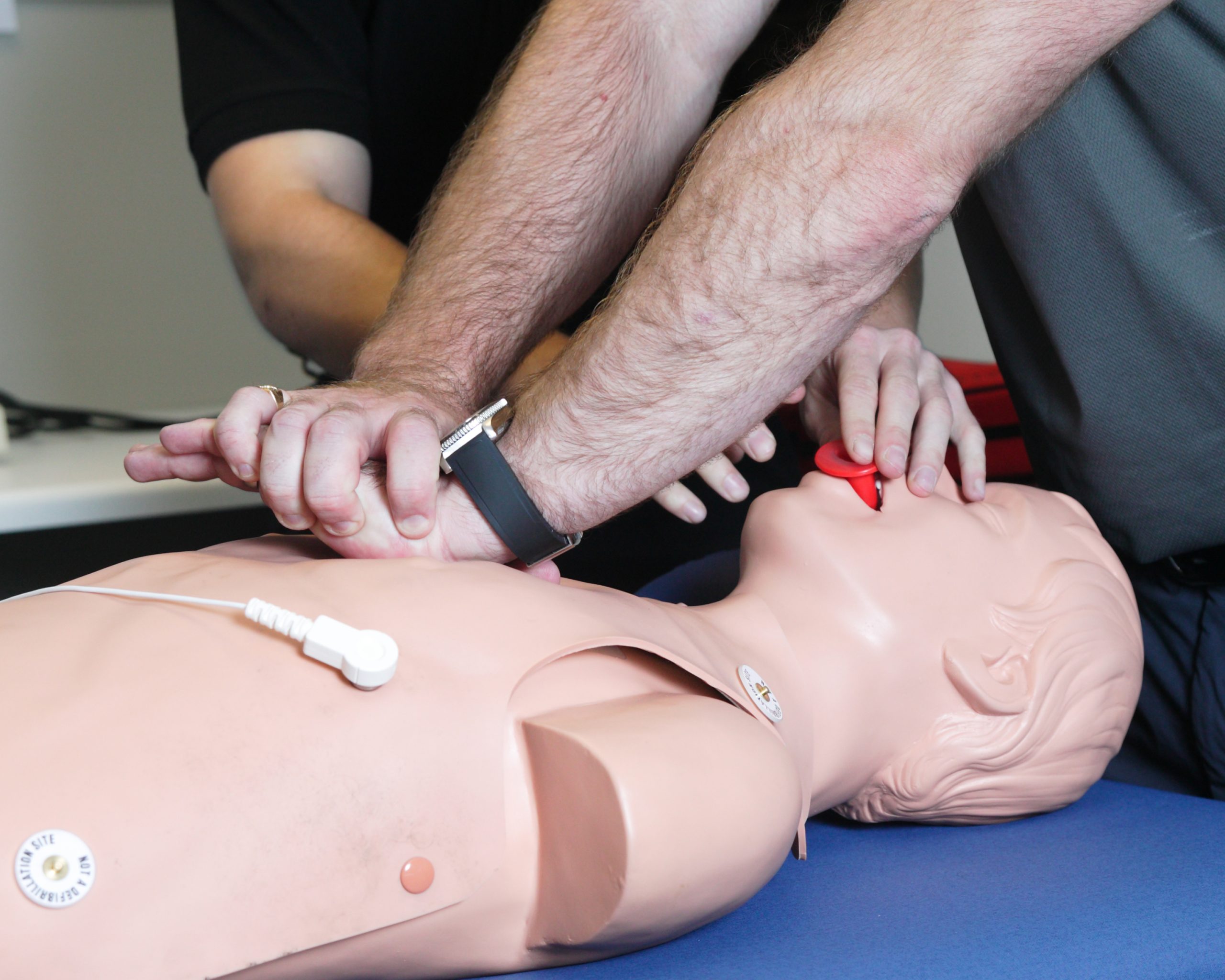
  • CPR — 30 compressions at 5–6cm and 100–120 per minute, two rescue breaths, assessed on the floor
  • Safe use of an AED, including pad placement
  • Choking — telling mild from severe, back blows and abdominal thrusts, and what changes if they lose consciousness
  • Life-threatening bleeding, wounds and shock
  • Minor injuries — small cuts, grazes, bruises, splinters, nosebleeds
  • Seizures — keeping the casualty safe, timing it, and care afterwards
  • Record keeping and reporting

Taught to Resuscitation Council UK Guidelines 2025. The adult sequence changed in October 2025 — you now call 999 for any unresponsive casualty before checking for breathing. If you last trained before 2026, that part is new.

The Qualsafe Level 3 Award in Emergency First Aid at Work (RQF), valid for three years.

How you are assessed

Practical demonstration through the day, plus one short multiple-choice paper taken in the room. If you are referred on an element you get the chance to be reassessed.

What it means for your employer

Nationally regulated, which is the cleanest way for your employer to evidence that they checked their provider — a duty that has sat with employers since HSE stopped approving providers in October 2013.

Your certificate carries the provider name, the qualification title, the reference to the Health and Safety (First-Aid) Regulations 1981, the start date and the three-year validity. That is the list an inspector works through.

HSE’s due-diligence guidance (GEIS3) sets out what an employer should check before choosing a provider. We will supply our Qualsafe centre approval, trainer and assessor records and quality assurance arrangements on request.

Keeping skills current afterwards

HSE recommends an annual refresher between three-yearly requalifications. It is a recommendation, not a legal requirement. Ours is the First Aid Annual Refresher online, about two and a half hours at a desk.

  • You are 14 or over on the day. No upper limit.
  • You can kneel and perform CPR on a manikin on the floor for at least two minutes. If that is difficult, tell us before booking — it is rarely a barrier and we would rather plan for it than discover it on the morning.
  • Your English is good enough to follow instruction and complete a short written paper. Support is available if you ask when booking.

No previous qualification required.

Renewing

EFAW has no shortened requalification route. Whether your certificate is current or lapsed, requalifying means the full one-day course again. That is an awarding-organisation rule and it applies everywhere, not just here.

Only First Aid at Work has a reduced route — the two-day requalification — and holding EFAW does not open it.

£125 including VAT per place — or £106.25 each when you book four or more. There are several ways to pay, and a few ways to pay less.

Multiple booking discount

Employers booking four or more learners receive 15% off the total, including any optional services added at checkout.

Returning learners

Trained with us before? When you come back to requalify, take 10% off your refresher.

Course fee money-back 100% guarantee

Attend the course, complete the learning and follow your tutor’s guidance. If you still do not pass, we refund your course fee. On eligible courses.

Secure your place with a 20% deposit

Pay 20% at checkout to secure your place on the date you want. The balance is due before your course starts.

Pay in full with Klarna

Choose Klarna at checkout and spread the cost on Klarna’s terms. Subject to Klarna’s eligibility checks.

Employer invoicing

Employers booking several people can be invoiced rather than paying at checkout. Get in touch and we will set it up.

This is usually your employer’s bill

If your workplace needs an emergency first aider, providing one is the employer’s duty under the Health and Safety (First-Aid) Regulations 1981. Ask before you pay for it yourself.

On-site delivery

For groups of ten or more, at your premises, usually cheaper per head. Ask for a quote.

Can one person book, or do I need a group?

One person is fine. Our dates are scheduled monthly and you book a seat on one. Most local providers only run group bookings, which is why a lone learner struggles to find anything.

Do I need EFAW or the full First Aid at Work?

It depends on your employer’s first aid needs assessment. EFAW is one day and covers immediate life-saving. FAW is three days and adds fractures, spinal and head injury, the secondary survey and a much wider range of medical emergencies. Lower-risk workplaces usually need EFAW. If you are unsure, call us.

How long does the certificate last?

Three years from the date you complete.

Is there a shorter course to renew it?

No. Unlike First Aid at Work, EFAW has no reduced requalification route — you repeat the full day. That rule comes from the awarding organisations and applies to every provider, so anyone offering you a shortened EFAW renewal is selling you something that will not stand up.

I hold EFAW and want to move up to FAW. What do I do?

Take the full three-day First Aid at Work course. Holding EFAW does not open the two-day requalification route — that is only for people who hold or recently held FAW itself.

Do I need an annual refresher?

It is recommended, not required. HSE strongly recommends annual refresher training between three-yearly requalifications, and states plainly that it is not mandatory. We run a short online annual refresher if you want one.

Is the course HSE approved?

No provider is — HSE stopped approving them in October 2013. What matters now is that your employer can show they chose a competent provider, and a regulated Qualsafe qualification is the simplest evidence of that.

How do I check a provider is competent?

HSE’s guidance (GEIS3) sets out what to ask for: qualifications from an Ofqual-regulated awarding organisation, appropriately qualified trainers and assessors, a working quality assurance system, and a syllabus and certification that meet the standard. We will send all of it on request.

How many people are on a course?

No more than twelve learners to one trainer, with one manikin per four and one AED trainer per four.

Who teaches it?

Registered clinicians who still work in practice, in a centre with proper simulation areas rather than a hired room.

What happens if I fail?

You get the chance to be reassessed. And if you attend, complete the learning and follow your tutor’s guidance and still do not pass, we refund your course fee.

Can you come to our workplace?

Yes, for groups of ten or more. It usually costs less per head than sending everyone to us, and nobody loses travel time. Contact us for a quote.

Are you teaching the current resuscitation guidelines?

Yes — Resuscitation Council UK Guidelines 2025, which replaced the 2021 guidelines in October 2025. It is worth asking any provider this, because HSE’s due-diligence guidance expects adult basic life support to follow current RCUK guidance, and not every provider has updated.

Where is the centre and is there parking?

Faraday House, Sopwith Close, Stockton-on-Tees TS18 3TT, with free parking directly outside. We are straight off the A19 and A66.

What do I need to bring?

Clothes you can kneel in. That is it.

Over 10,000 people have begun their clinical career with us.

We support NHS ambulance services, dental practices, community pharmacies, care providers and offshore operators. Here is what some of them say.

Want to know more?

Complete our short online form for more information about any of our programmes or to find out how we can work with your organisation to develop your employees

Get In Touch Today
Menu
Basket

No products in the basket.

Basket

No products in the basket.