Qualification Code:

FAAWR

Awarding Body:

Qualsafe Awards

Duration:

2 days

Delivery Method:

Classroom

Cost:

£185 (VAT included)


Course Overview

Two days to requalify, instead of three to start again

Your First Aid at Work certificate runs out after three years. This is the two-day course that renews it.

Trained with us before? Save 10%. Returning learners get a 10% loyalty discount on this refresher. Most receive a reminder with the code before their certificate expires. If you have not had yours, call 01325 609030.

It awards the same qualification as the three-day course — the Qualsafe Level 3 Award in First Aid at Work (RQF) — and the certificate is valid for a further three years. You cover the same ground in twelve hours instead of eighteen, because you are not learning it for the first time.

That saved day is the whole point. For an employer putting three or four first aiders through, it is three or four working days back.

Where you will do it

In our own training centre in Stockton-on-Tees, in simulation areas built to look like the places people actually collapse — not a hired room with a mat on the floor. You will work through scenarios in them rather than talk about them.

Every course is taught by registered medical professionals who still practise. When someone asks what really happens when the ambulance arrives, the answer comes from last week, not from a manual.

Class sizes are capped at twelve learners to one trainer, with one manikin per four and one AED trainer per four.

You can book one place

Most first aid training is sold to groups, because that is the only way it works for a trainer with a car full of manikins. We run scheduled dates every month, so one person can book one place on a date that suits them. No waiting until you have enough people to make a course worth running.

If you do have a group, we will come to your site anywhere in the country, provided there are at least ten of you.

Taught to the current guidelines

Resuscitation Council UK published new guidelines in October 2025, replacing the 2021 set and changing the adult sequence. If you last requalified before then, part of what you were taught has since changed. This course teaches the 2025 guidelines.

Before you book, check two things

You need to hold, or have recently held, a First Aid at Work certificate — and you will need to produce it. An Emergency First Aid at Work certificate does not qualify you for this route; that leads to the full three-day First Aid at Work course.

If yours expired more than a month ago, read the Pre-entry criteria below before booking. We will contact you about it either way.

The requalification covers the full First Aid at Work syllabus — both qualification units — at the pace of someone who has done it before. Everything below is assessed.

The role, and reading the scene

  • What a first aider is responsible for — assessing an incident, prioritising treatment, summoning help, recording what happened, and dealing with the stress afterwards
  • Infection control — PPE, hand hygiene, barrier devices, safe disposal
  • Consent, including implied consent for a casualty who cannot give it
  • The primary survey — DR C ABCDE, including life-threatening bleeding before airway

The unresponsive casualty

  • Adult CPR — 30 compressions at 5–6cm and 100–120 per minute, two rescue breaths, assessed at floor level
  • Safe use of an AED, including pad placement
  • The recovery position, and continual monitoring of breathing once the casualty is in it
  • Seizures — keeping the casualty safe, timing it, and what to do afterwards
  • Choking — telling mild from severe, back blows and abdominal thrusts, and what changes when they lose consciousness

Bleeding, shock and wounds

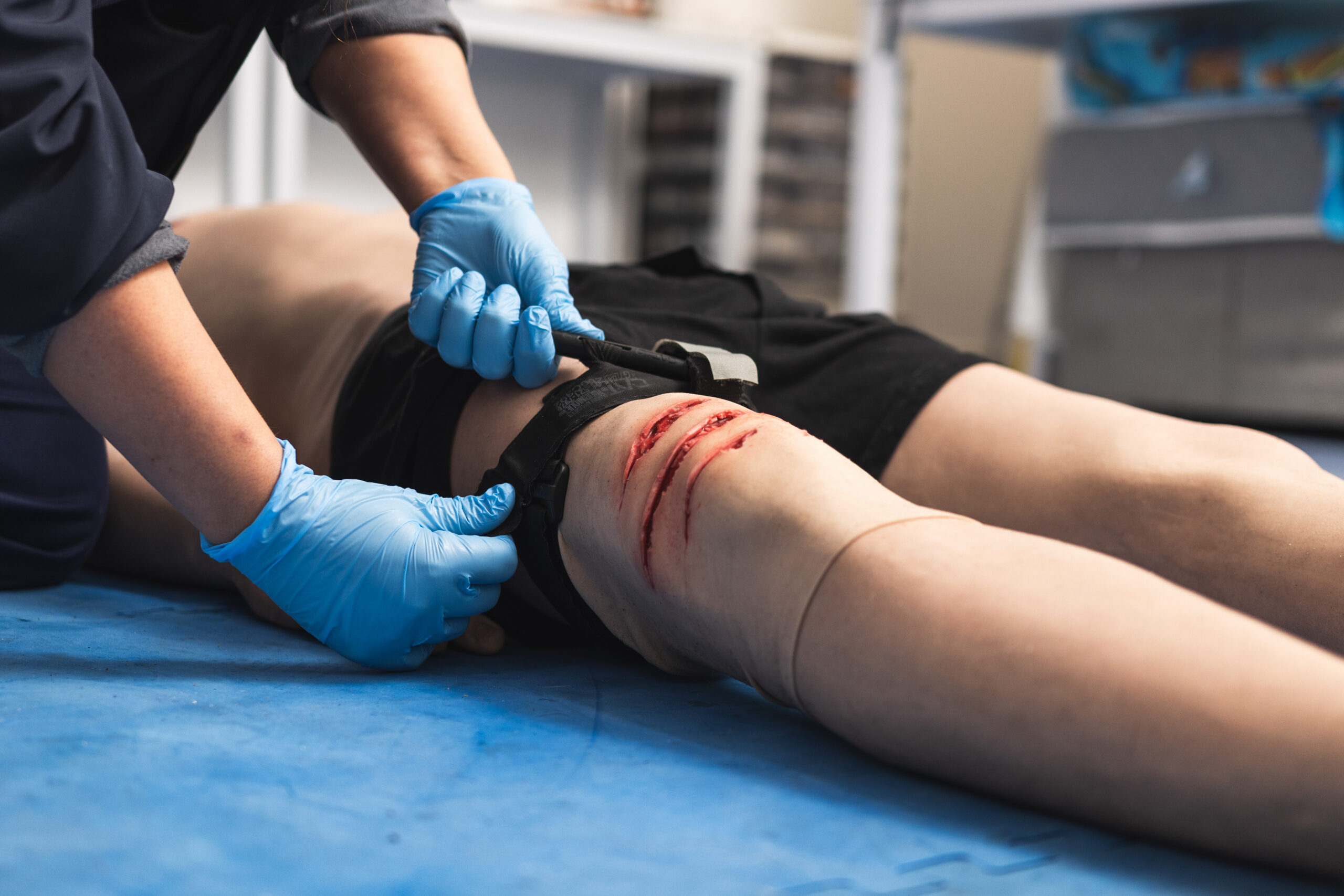
  • Life-threatening bleeding — recognising it, wound packing, and tourniquet use including improvised
  • Controlling external bleeding and dressing a wound
  • Shock — recognising it, including on dark skin tones, and treating it
  • Minor injuries — cuts, grazes, bruises, splinters, nosebleeds, minor burns and scalds

The secondary survey and injuries

  • Casualty history and a systematic head-to-toe survey
  • Fractures, dislocations, sprains and strains, and applying support and elevated slings
  • Head and spinal injuries — the jaw thrust, keeping the head and neck in line, and moving a casualty whose airway is at risk
  • Chest injuries, including penetrating chest wounds
  • Burns and scalds — dry and wet heat, chemical and electrical
  • Eye injuries — dust, chemicals and embedded objects

Sudden illness

  • Anaphylaxis — recognition, and giving adrenaline with an auto-injector training device
  • Heart attack and stroke, including the FAST test
  • Asthma attack, including assisting with an inhaler and spacer
  • Hypoglycaemia, and giving 15–20g of glucose
  • Poisoning — ingested, inhaled, absorbed and injected, and how corrosive substances change the response

The Qualsafe Level 3 Award in First Aid at Work (RQF), qualification number 603/2384/X — the same regulated qualification awarded by the three-day course, and valid for three years from the date of achievement.

Qualsafe Awards is an Ofqual-regulated awarding organisation. The qualification sits on the Regulated Qualifications Framework and is the one HSE guidance refers to for workplaces whose first aid needs assessment calls for a First Aid at Work provider.

How you are assessed

Assessment is continuous across the two days, plus two short written papers. There is no surprise exam at the end — your trainer will have seen you perform everything before you are signed off.

  • Practical assessment of CPR and safe use of an AED; a choking casualty; an unconscious casualty; wounds, bleeding and shock; a secondary survey; management of fractures; and management of anaphylaxis
  • Two multiple-choice papers — one of 15 questions, one of 25 — taken in the classroom
  • An optional additional assessment in managing catastrophic bleeding [[CONFIRM — the qualification makes this one optional. If you run it as standard, finish the line with “which we include as standard”. If you do not, delete this bullet.]]

If you are referred on any element, you have the chance to be reassessed. The qualification must be completed within ten weeks of starting, including any reassessment.

What HSE expects after this

HSE recommends first aiders take an annual refresher in the years between requalifications, to stop skills decaying across a three-year gap. That is a separate, shorter course — it keeps you sharp but it does not extend your certificate. Ours is the First Aid Annual Refresher online, which takes about two and a half hours and can be done at a desk.

HSE stopped approving first aid training providers in October 2013. Since then the duty sits with you as the employer to satisfy yourself the provider is competent. HSE’s own guidance (GEIS3) sets out what to check — we can supply all of it, and the FAQ below covers what to ask for.

Three conditions, and one warning.

You must hold a First Aid at Work certificate

Current, or recently expired. You will need to produce it on the first morning — a photograph of it is fine. Without it we cannot put you through the two-day route, because the regulated qualification does not allow it.

An Emergency First Aid at Work certificate does not count. EFAW and FAW are different qualifications, and only FAW can be requalified this way. If EFAW is what you hold, the three-day First Aid at Work course is the one you need.

You must be 14 or over on the first day

A requirement of the qualification. Most workplaces will want first aiders considerably older, but 14 is the floor set by the awarding organisation.

You must be able to work at floor level

CPR is assessed on the floor, on a manikin, for a minimum of two minutes. If kneeling or getting down to the floor is difficult, speak to us before booking — tell us early and we will usually find a way, but we would rather have that conversation now than on the morning.

The qualification has no formal literacy or numeracy entry requirement, though there are two written papers, so Level 1 English is a sensible benchmark. If anyone in your group would struggle with a written paper, tell us when you book and we will make arrangements.

If your certificate expired more than a month ago, read this

You can still take the two-day course. But we are required to tell you — and we would anyway — what you are taking on:

  • The two-day course covers the same syllabus as the three-day in twelve hours instead of eighteen. The pace is significantly faster.
  • HSE’s position is that once a certificate expires, the holder is no longer considered competent to act as a first aider. The longer the gap, the more there is to rebuild.
  • The risk of being referred on an assessment is higher.
  • HSE suggests it may be prudent to do the three-day course instead.

We will contact you before your course to talk this through, and if the three-day course is the better bet we will say so and move your booking. We would rather move you than fail you.

£185 including VAT per place — or £157.25 each when you book four or more. Covers the two days, all assessment, your certificate and the course materials.

Multiple booking discount

Employers booking four or more learners receive 15% off the total, including any optional services added at checkout. Most workplaces requalify their first aiders together, so this usually applies.

Returning learners

Trained with us before? When you come back to requalify, take 10% off your refresher. If you took your original First Aid at Work with us, that applies here.

Course fee money-back 100% guarantee

Attend the course, complete the learning and follow your tutor’s guidance. If you still do not pass, we refund your course fee. On eligible courses.

Secure your place with a 20% deposit

Pay 20% at checkout to secure your place on the date you want. The balance is due before your course starts.

Pay in full with Klarna

Choose Klarna at checkout and spread the cost on Klarna’s terms. Subject to Klarna’s eligibility checks.

Employer invoicing

Employers putting several people through can be invoiced monthly rather than per booking. Get in touch and we will set it up.

On-site delivery

For groups of ten or more we deliver at your premises anywhere in the country, which removes travel and lost time as well as cost. Ask for a quote.

My certificate expires next month. When should I book?

Before it expires. Requalify while the certificate is still current and the new three years run on cleanly, with no gap in which your workplace is uncovered. We run dates every month, so book the one that lands a few weeks before expiry rather than the week after.

What happens if I let it lapse?

You can still take the two-day course. But HSE’s position is that once the certificate expires you are no longer considered competent to act as a first aider, so your employer is a first aider short from the expiry date. If it lapsed more than a month ago we will contact you before the course to talk through whether the three-day course would be the safer option.

Is this the same qualification as the three-day course?

Yes. Both award the Qualsafe Level 3 Award in First Aid at Work (RQF), qualification number 603/2384/X, valid for three years. The difference is the time taken — twelve hours rather than eighteen — because you are renewing rather than starting.

Is this the same as an annual refresher?

No, and the difference matters. An annual refresher is a short top-up HSE recommends in the years between requalifications; it keeps skills from decaying but it renews nothing. This course renews your certificate for three years. If what you need is the annual top-up, that is our First Aid Annual Refresher online.

I hold Emergency First Aid at Work. Can I do this?

No. EFAW and FAW are separate qualifications, and the two-day requalification route is only open to people who hold or recently held FAW. If EFAW is what you have, you would take the three-day First Aid at Work course to move up.

Can one person book, or do I need a group?

One person is fine. We schedule dates every month and sell single places on them, which most of the first aid market does not do — the usual model is to sell a whole course to one employer. If you are the only person in your business who needs it, you can still book this week.

Can you come to us instead?

Yes, anywhere in the country, provided there are at least ten of you. We bring the manikins, AED trainers, auto-injector training devices and everything else. You need a room with space to work on the floor.

How many people are on a course?

The qualification caps it at twelve learners to one trainer. We also work to one manikin per four learners and one AED trainer per four, so nobody spends the day watching someone else practise.

Who teaches it?

Registered medical professionals who still practise clinically. It is the reason our scenarios are built the way they are, and the reason the answers to “what actually happens next” come from experience rather than a manual.

How do I know you are a competent provider?

HSE stopped approving first aid training providers in October 2013, which put the duty of checking onto you as the employer. HSE’s guidance (GEIS3) sets out what to ask for: that the provider holds qualifications from an Ofqual-regulated awarding organisation, that trainers and assessors are appropriately qualified, that there is a quality assurance system, and that syllabus and certification meet the standard. We will send all of it on request, including our Qualsafe centre approval and trainer records.

What happens if I fail?

You get the chance to be reassessed on whatever you were referred on, provided the qualification is completed within ten weeks of starting. And if you attend, complete the learning and follow your tutor’s guidance and still do not pass, we refund your course fee.

Does this meet the 2025 resuscitation guidelines?

Yes. Resuscitation Council UK published new guidelines in October 2025, replacing the 2021 set and changing the adult sequence. Everything on this course is taught to the 2025 guidelines. If you last requalified before October 2025, some of what you were taught has since changed.

Where is the centre and is there parking?

Faraday House, Sopwith Close, Stockton-on-Tees TS18 3TT, with free parking directly outside. We are straight off the A19 and A66.

What do I need to bring?

Your existing First Aid at Work certificate, or a photograph of it, and clothing you can kneel and work on the floor in. Everything else is provided.
Over 10,000 people have begun their clinical career with us.

We support NHS ambulance services, dental practices, community pharmacies, care providers and offshore operators. Here is what some of them say.

Want to know more?

Complete our short online form for more information about any of our programmes or to find out how we can work with your organisation to develop your employees

Get In Touch Today
Menu
Basket

No products in the basket.

Basket

No products in the basket.