Qualification Code:

PFPT

Awarding Body:

CPD Credits

Duration:

3 day

Delivery Method:

Classroom & Online

Cost:

£500 (VAT included)


Course Overview

The clinical skills Pharmacy First actually asks for

Three days of hands-on clinical skills for pharmacy technicians delivering Pharmacy First.

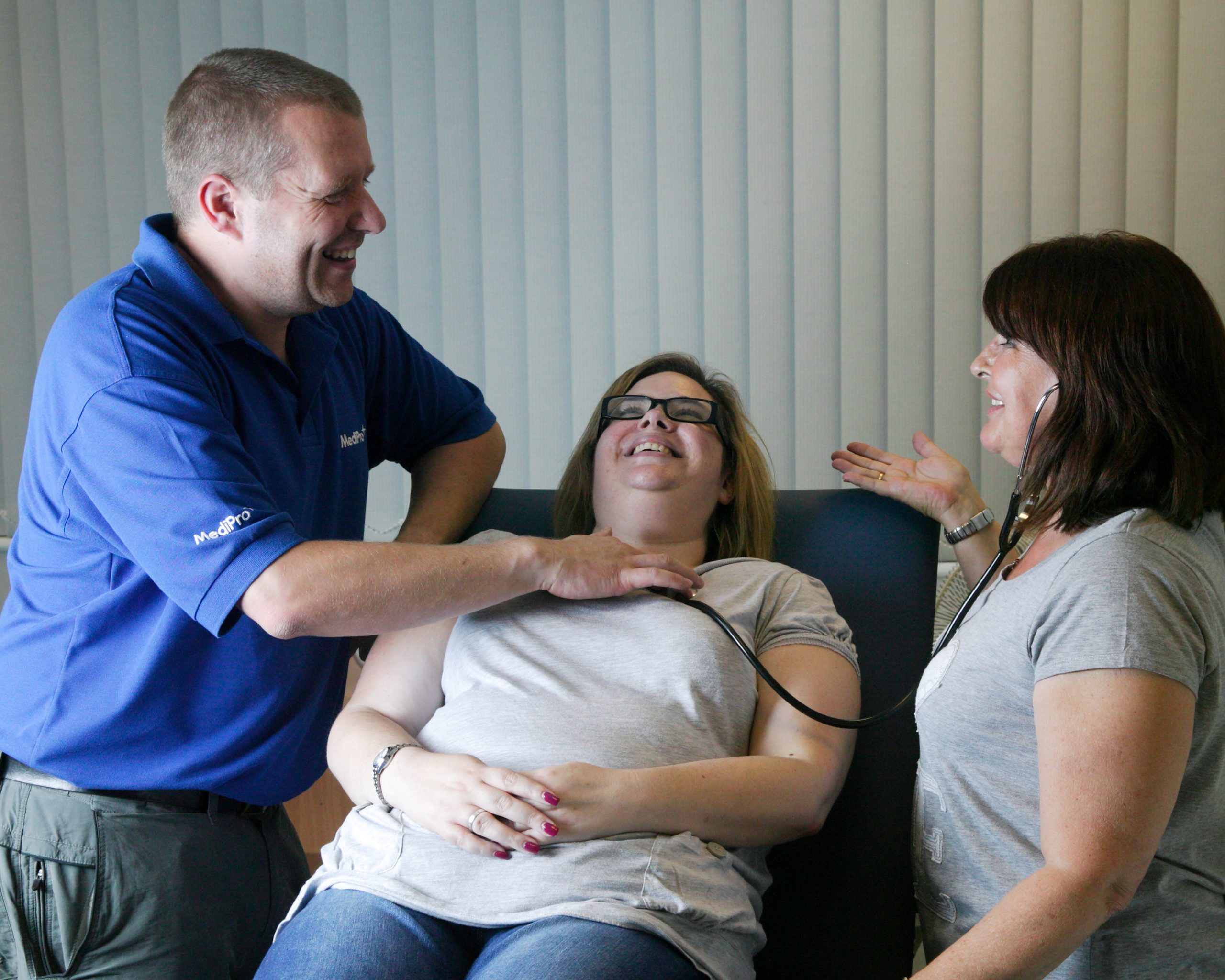
All the underpinning theory sits in thirteen online modules you complete before you come. That leaves three full days in our Stockton-on-Tees centre for examining, assessing and practising — otoscopy, throat examination, blood pressure, peak flow, point-of-care testing — under a faculty of advanced nurse practitioners, paramedics and GPs.

Check you are eligible before you book

This course is for registered pharmacy technicians. To enrol you need to:

  • be currently registered with the General Pharmaceutical Council as a pharmacy technician; and
  • be employed or working in a clinical healthcare setting that delivers NHS services, with employer support to apply the skills in practice.

The employer support matters as much as the registration. These are skills you have to use and be governed on in your own workplace — there is little point learning otoscopy if nobody at your practice is going to let you do it.

Built around the national specification

The content is mapped to all thirteen Level 4 learning-outcome domains in NHS England’s specification for pharmacy technician clinical skills — from clinical assessment and interpretation of observations through to public health, governance and multiprofessional working.

The knowledge domains are delivered and assessed online. The hands-on domains are delivered and assessed across the three days. The reasoning, communication and documentation domains are built online and then applied in the OSCE stations.

What the three days look like

Each day runs roughly 9:00 to 16:30, taught through demonstration, supervised practice, peer-to-peer work and simulation.

  • Day 1 — foundations of clinical assessment and consultation. Scope, competence and PGDs. Structured history taking and safety-netting with observed peer consultation. Vital signs demonstrated and practised — manual and automated blood pressure, pulse, respiratory rate, oxygen saturation, temperature. Peak flow technique and interpretation. Point-of-care testing: capillary blood glucose, cholesterol and urinalysis. Then documentation, escalation and an end-of-day skills circuit.
  • Day 2 — systems examination and the Pharmacy First pathways. ENT examination including otoscopy for acute otitis media, throat examination with FeverPAIN and Centor scoring, and acute sinusitis. Skin assessment for impetigo, shingles and infected insect bites, including spreading cellulitis as a red flag. Focused respiratory and cardiovascular assessment and the hypertension pathway. Uncomplicated UTI in women. Then simulated Pharmacy First consultations across the pathways.
  • Day 3 — applied skills, long-term conditions and assessment. Practical stations for diabetes including HbA1c and foot-check awareness, respiratory including inhaler technique and asthma and COPD review, and cardiovascular including CVD risk. Recognising the deteriorating patient using NEWS2 and escalating with SBAR. Then the integrated simulation circuit and the summative OSCE assessment, finishing with action planning and portfolio evidence for the workplace.

Who teaches it

A multidisciplinary faculty of advanced nurse practitioners, paramedics and GPs with frontline experience. For a technician learning to examine an ear or interpret a blood pressure trend, being taught by people who do it daily is the point.

You can add the following when booking your course. It is not included in the £500 course fee.

Accommodation – from £75 per night

Add the number of nights you need at our learner rate. Three classroom days means three nights. At £75 that is £225, with breakfast and parking included. See the Accommodation section below for full details.

Delivered across the online eLearning and three classroom days, you will develop the knowledge and practical skills to:

  • Consultation and communication – carry out structured, person-centred consultations, using shared decision-making and clear safety-netting.
  • Clinical assessment skills – perform and interpret blood pressure, pulse, respiratory rate, oxygen saturation, temperature, peak flow, blood glucose, cholesterol and urinalysis.
  • Physical examination – focused ENT, respiratory, cardiovascular and skin assessment mapped to the Pharmacy First pathways.
  • The Pharmacy First pathways – assess and manage sore throat, acute otitis media, sinusitis, impetigo, infected insect bites, shingles and uncomplicated UTI in women.
  • Clinical reasoning – prioritise, apply critical thinking, recognise the limits of competence and escalate risk appropriately.
  • Long-term conditions – support the review and monitoring of cardiovascular disease, respiratory disease, diabetes and mental health.
  • Interpreting data and observations – make sense of observations, test results and trends, and recognise the deteriorating patient.
  • Public health and prevention – deliver prevention and health-improvement interventions and brief lifestyle advice.
  • Governance and documentation – work within legal, ethical and professional frameworks including PGDs, and keep accurate, compliant records.
  • Integrated and multiprofessional care – work across teams and settings and support safe transfer of care.

The thirteen online modules

Each ends with a knowledge check, and the full set must be completed to unlock your place on the face-to-face days.

  1. The Evolving Pharmacy Technician Role and Scope of Practice
  2. Legal, Ethical and Governance Frameworks for Clinical Practice — GPhC standards, medicines legislation, PGDs and delegated responsibilities, consent, confidentiality, safeguarding, incident reporting.
  3. Consultation and Communication Skills for Person-Centred Care — structured consultation using Calgary–Cambridge, shared decision-making, health literacy and culture.
  4. Applied Clinical Knowledge: Pharmacology, Therapeutics and Treatment Pathways
  5. Clinical Reasoning, Decision-Making and Safety-Netting — prioritising, recognising the limits of competence, identifying and escalating clinical risk.
  6. Common Acute Presentations and the Pharmacy First Clinical Pathways — the national pathways, their assessment criteria, red flags and referral thresholds.
  7. Supporting the Management of Long-Term Conditions — cardiovascular, respiratory, diabetes and mental health.
  8. Clinical Observations and Vital Signs: Principles and Interpretation — normal versus abnormal ranges, the significance of trends, and when a finding means escalation.
  9. Interpreting Clinical Data and Laboratory Results — therapeutic drug monitoring, U&Es, LFTs, FBC, HbA1c, drug levels and renal function.
  10. Public Health, Prevention and Health Improvement — smoking cessation, vaccination, NHS Health Checks, antimicrobial stewardship and health inequalities.
  11. NHS Commissioned Clinical Services and Pathways — Pharmacy First, blood pressure check service, oral contraception service and NHS Health Checks.
  12. Clinical Documentation, Record Keeping and Information Governance
  13. Multiprofessional Working, Integrated Care and Quality Improvement — including audit, service evaluation and using data to support improvement.

A MediPro Level 4 CPD certificate in Pharmacy First and Clinical Skills for Pharmacy Technicians, confirming the CPD hours completed and the clinical competencies assessed.

How you are assessed

  • Knowledge checks on each of the thirteen online modules — all must be passed to unlock your classroom place
  • Observed consultation on Day 1, with feedback
  • Practical observation of clinical assessment skills across all three days
  • Simulated Pharmacy First consultations on Day 2
  • Summative OSCE stations on Day 3, spanning the acute pathways, vital signs and long-term condition reviews, assessed against defined criteria with individual feedback

Evidence for your workplace

Day 3 finishes with action planning and portfolio evidence you take back with you. Most employers want to see training evidence before signing a technician off to work to a service specification, and this is designed to be that evidence.

It is CPD rather than a regulated qualification. What you are permitted to do afterwards is set by your employer’s governance and the relevant service specification or PGD, not by the certificate.

This course is designed for registered pharmacy technicians. To enrol, learners should:

  • be currently registered with the General Pharmaceutical Council (GPhC) as a pharmacy technician; and
  • be employed or working in a clinical healthcare setting that delivers NHS services, with employer support to apply the skills in practice.

All learners complete the online eLearning modules before attending the three face-to-face days. The full set has to be finished — it is what unlocks your place.

If you are a technician without employer backing yet, speak to us before booking. It is usually worth having that conversation with your employer first, because the skills need somewhere to be used.

£500 including VAT — or £425 each when you book four or more. Covers the thirteen online modules, all three classroom days, assessment and your certificate.

Multiple booking discount

Organisations booking four or more learners receive 15% off the total, including any optional services added at checkout. For a group putting a team of technicians through together, that is £300 back on four places.

Returning learners

Trained with us before? When you come back to requalify, take 10% off your refresher.

Course fee money-back guarantee

Attend the course, complete the learning and follow your tutor’s guidance. If you still do not pass, we refund your course fee. On eligible courses.

Secure your place with a 20% deposit

Pay 20% at checkout to secure your place on the date you want. The balance is due before your course starts.

Pay in full with Klarna

Choose Klarna at checkout and spread the cost on Klarna’s terms. Subject to Klarna’s eligibility checks.

Employer invoicing

Most learners on this course are funded by their employer. We invoice directly rather than asking you to pay and reclaim. Get in touch and we will set it up.

In-house delivery

For groups of ten or more we deliver the classroom days at your premises. Your technicians complete the eLearning beforehand as usual. Ask for a quote.

Staying overnight

Travelling to us from outside Teesside? We have agreed learner rates with the Sporting Lodge Inn at Stainton, a 5 to 10 minute drive from our Stockton-on-Tees centre, with easy access from the A19 and A174.

  • £75 per night — bed and breakfast
  • £95 per night — dinner, bed and breakfast, including a two-course evening meal and a drink

Both rates include free on-site parking and free use of the hotel gym and 25-metre pool. There is a pub and restaurant on site.

These rates are only available through us, not directly with the hotel. Add the nights you need to your checkout when you book your course, and we will arrange it and confirm the details with you.

Three classroom days means three nights. At £75 that is £225, with breakfast and parking included.

Rooms are subject to availability, so book as early as you can. Plans change — cancel your room up to 24 hours before arrival and we will refund it.

Download our Teesside accommodation and local area guide for learners (PDF)

Our centre is Faraday House, Sopwith Close, Stockton-on-Tees, TS18 3TT, with free on-site parking and direct access from the A66 and A19.

By rail

Darlington sits on the East Coast Mainline, under three hours from London King’s Cross, with direct services from Edinburgh, Newcastle, York and Leeds. Eaglescliffe is the nearest station to the centre, with parking, cycle storage and ticket facilities.

By air

Teesside International Airport is around twenty minutes away and Newcastle Airport about an hour, with direct flights from Aberdeen, Belfast and Dublin.

What it costs to attend

Teesside is straightforward to reach from anywhere in the UK, and cheaper to stay in than most training locations. Three nights and three days away from the pharmacy, with the theory already done at home, is the whole reason the course is built this way.

Do I need to be GPhC registered?

Yes. This course is for registered pharmacy technicians, and GPhC registration is an entry requirement. It is not suitable for pharmacy assistants or dispensers.

Do I need my employer’s support?

Yes, and it matters as much as the registration. You need to be working in a clinical setting that delivers NHS services, with employer backing to use the skills. There is little point learning otoscopy if nobody at your workplace will let you do it. If you do not have that yet, ring us before booking.

Does this cover the full Pharmacy First service?

The clinical pathways, yes — sore throat, acute otitis media, sinusitis, impetigo, infected insect bites, shingles and uncomplicated UTI in women, with the assessment criteria, red flags and referral thresholds for each. It also covers the blood pressure check service, oral contraception service and NHS Health Checks.

Will I learn to use an otoscope?

Yes. Otoscopy and ear examination are taught and practised on Day 2, alongside throat examination with FeverPAIN and Centor scoring, and assessment of acute sinusitis.

Is it mapped to the NHS England specification?

Yes — all thirteen Level 4 learning-outcome domains. The knowledge domains are delivered and assessed online, the hands-on domains across the three days, and the reasoning and documentation domains are built online then assessed in the OSCE stations.

What clinical measurements will I be able to take?

Blood pressure both manual and automated, pulse, respiratory rate, oxygen saturation, temperature, peak flow, capillary blood glucose, cholesterol and urinalysis — performed and interpreted, including when a result means escalation.

Do I have to finish the eLearning first?

Yes, and it is enforced — the full set of thirteen modules must be completed to unlock your place on the face-to-face days. The classroom time assumes the theory is done.

How am I assessed?

Knowledge checks on every online module, an observed consultation on Day 1, practical observation throughout, simulated Pharmacy First consultations on Day 2, and summative OSCE stations on Day 3 with individual feedback.

Does the certificate authorise me to work to a PGD?

No. It evidences the training and the competencies assessed. What you are permitted to do is set by your employer’s governance and the relevant service specification or PGD. Most employers want training evidence of this kind before signing a technician off, which is what this provides.

Do I get anything to take back to work?

Yes. Day 3 finishes with action planning and portfolio evidence designed for exactly that conversation with your employer.

Who teaches it?

A multidisciplinary faculty of advanced nurse practitioners, paramedics and GPs with frontline clinical experience.

Is NEWS2 covered?

Yes, on Day 3 — bringing observations together, early warning scoring and structured escalation and handover using SBAR.

Can you train our whole technician team?

Yes, for ten or more, at your premises, with 15% off at four or more in any case. Your technicians complete the eLearning beforehand. Ask us for a quote.

Where is the centre and is there parking?

Faraday House, Sopwith Close, Stockton-on-Tees TS18 3TT, with free parking directly outside.

Over 10,000 people have begun their clinical career with us.

We support NHS ambulance services, dental practices, community pharmacies, care providers and offshore operators. Here is what some of them say.

Want to know more?

Complete our short online form for more information about any of our programmes or to find out how we can work with your organisation to develop your employees

Get In Touch Today
Menu
Basket

No products in the basket.

Basket

No products in the basket.