Qualification Code:

PFA

Awarding Body:

Qualsafe Awards

Duration:

2 days

Delivery Method:

Classroom

Cost:

£200 (VAT included)


Course Overview

The paediatric certificate the EYFS requires

This is the full 12-hour course — the one EYFS actually requires. Two days, and you can book a single place on any of our scheduled monthly dates.

That last point matters if you are a childminder. You cannot assemble a group, and most local first aid providers only sell to groups. We run Paediatric First Aid monthly at our Stockton-on-Tees centre and you can book one seat.

Who needs the full course rather than the one-day

Under the EYFS statutory framework, several requirements can only be met by someone holding a full-course paediatric first aid certificate — the 12-hour one. The six-hour emergency version does not satisfy them.

  • Childminders need the full 12-hour PFA to register, and must hold it for as long as they are registered. Emergency PFA is not enough.
  • Group and school-based settings must have someone with a full-course certificate on the premises and available whenever children are present, and on outings.
  • At mealtimes, a member of staff with a valid full-course certificate must be in the room while children are eating.
  • Staff ratios. Anyone who gained a level 2 or level 3 childcare qualification on or after 30 June 2016 must hold a paediatric first aid certificate to be counted in ratios.

If you are unsure which you need, ring us before you book. We would rather spend five minutes on the phone than have you buy the wrong course.

Where you will train

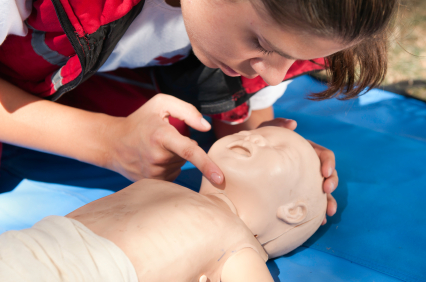
Our own centre, with dedicated simulation areas and infant and junior manikins — not adult manikins pressed into service. Infant CPR is genuinely different and cannot be learned on an adult torso.

Tutors are registered clinicians who still practise. On a paediatric course that counts for a great deal, because the questions people actually want answered are the ones that start “what if it was my own”.

What the two days look like

  • Day 1. The role of the paediatric first aider, assessing an emergency involving a child, the unresponsive infant and child, paediatric CPR, choking, bleeding and shock.
  • Day 2. Anaphylaxis, asthma, febrile convulsions and seizures, meningitis, head and spinal injuries, burns, fractures, poisoning, bites and stings, diabetic emergencies — then scenario practice and assessment.

Days run 9:00 to 16:30 with breaks, free parking directly outside.

Or we come to you

For nurseries, pre-schools and school staff teams we deliver on site, for groups of ten or more. Your staff do not travel, you lose less cover, and it usually works out cheaper per head than sending people out one at a time across several weeks.

Twelve contact hours across two days, covering infants and children.

  • The role of the paediatric first aider — including consent and safeguarding awareness
  • Assessing an emergency involving a child, and your own safety
  • Infection control in a childcare setting
  • The unresponsive infant and child — airway, breathing, recovery position
  • Paediatric CPR — infant and child, and how it differs from adult
  • Safe use of an AED on a child, including paediatric pads and capability
  • Choking — infant and child, back blows and chest or abdominal thrusts
  • Bleeding, wounds and shock
  • Anaphylaxis — recognition and auto-injector use with a training device
  • Asthma and breathing difficulties, including inhaler and spacer
  • Febrile convulsions and seizures
  • Meningitis — the signs that matter and when to act
  • Head, neck and back injuries
  • Burns, scalds, fractures and dislocations
  • Poisoning, bites and stings
  • Diabetic emergencies
  • Conditions affecting the eyes, ears and nose, including foreign objects
  • Record keeping and what to report to parents and to Ofsted

Taught to Resuscitation Council UK Guidelines 2025, which replaced the 2021 guidelines in October 2025.

Assessed by practical demonstration across both days plus short written papers. The emergency elements are delivered and assessed face to face, as the framework requires.

A regulated Level 3 Paediatric First Aid qualification, valid for three years, meeting the full 12-hour requirement set out in the EYFS statutory framework.

What that lets you do

It satisfies the EYFS requirements that specify a full-course certificate: registering as a childminder, being the designated paediatric first aider on the premises and on outings, and being the staff member present at mealtimes.

It also counts toward staff ratios. Anyone who gained a level 2 or level 3 childcare qualification on or after 30 June 2016 must hold a paediatric first aid certificate to be counted — and has three months from starting work to get one.

Evidence for Ofsted

Ofsted may ask to see it. The framework expects settings to display certificates, or a list of who holds them, where parents and carers can see.

Keep the certificates together with your dates of expiry. The most common finding is not that a setting never trained anyone — it is that the certificate lapsed and nobody noticed until the inspection.

  • You are 16 or over.
  • You can kneel and work on a manikin on the floor. Tell us in advance if that is difficult and we will work it out with you.
  • Your English is good enough to follow instruction and complete short written papers. Ask when booking if you would like support.

No previous qualification or childcare experience required — though most people on the course work with children already.

Renewing

Certificates last three years and you repeat the full course to renew. There is no shortened route for paediatric first aid.

Book before it expires. If it lapses you are not counted for EYFS purposes until you requalify, which can leave a setting short at short notice — and a childminder unable to operate at all.

£200 including VAT per place — or £170 each when you book four or more. There are several ways to pay, and a few ways to pay less.

Multiple booking discount

Settings booking four or more staff receive 15% off the total, including any optional services added at checkout. For most nurseries that is the whole room team in one booking.

Returning learners

Trained with us before? When you come back to requalify, take 10% off your refresher.

Course fee money-back 100% guarantee

Attend the course, complete the learning and follow your tutor’s guidance. If you still do not pass, we refund your course fee. On eligible courses.

Secure your place with a 20% deposit

Pay 20% at checkout to secure your place on the date you want. The balance is due before your course starts.

Pay in full with Klarna

Choose Klarna at checkout and spread the cost on Klarna’s terms. Subject to Klarna’s eligibility checks.

Settings invoicing

Settings booking several staff can be invoiced rather than paying at checkout. Get in touch and we will set it up.

Childminders

If you are self-employed, this is an allowable business expense. Keep the receipt.

On-site delivery

For nurseries, pre-schools and school staff teams we deliver on site for groups of ten or more. It usually works out cheaper per head than sending staff out, and you can train a whole team without losing cover across several weeks.

Does this course meet the EYFS requirement?

Yes. This is the full 12-hour paediatric first aid course set out in the EYFS statutory framework, and it meets the requirements that specify a full-course certificate.

I am registering as a childminder. Is the one-day course enough?

No. Childminders must hold the full 12-hour paediatric first aid certificate to register, and must keep it current for as long as they are registered. The six-hour Emergency Paediatric First Aid course does not satisfy that.

What is the difference between Paediatric First Aid and Emergency Paediatric First Aid?

Twelve hours against six. The emergency course covers immediate life-saving — unresponsive infants and children, CPR, choking, bleeding and basic emergencies. The full course adds a much wider range of illnesses and injuries, and is the one EYFS requires for registration, for the designated first aider on the premises, and for mealtimes.

Can I book one place, or do I need a group?

One place is fine, on any of our scheduled monthly dates. This is the main difference between us and most local providers, who only sell group bookings — which is awkward if you are a childminder or a single member of staff.

I have just qualified at level 3. How long have I got to do this?

If you gained your level 2 or level 3 qualification on or after 30 June 2016, you need a paediatric first aid certificate within three months of starting work to be counted in staff ratios. Do not leave it to the last fortnight — our dates are monthly and they fill.

How long does the certificate last?

Three years. You repeat the full course to renew — there is no shortened route for paediatric first aid, unlike First Aid at Work.

What happens if my certificate lapses?

You stop counting for EYFS purposes from the expiry date. For a setting that can mean being out of ratio without realising; for a childminder it can mean being unable to operate. Diarise it at two years and nine months.

Do I need an annual refresher?

It is not required. The framework says settings “should consider” whether annual refresher training is needed within the three-year cycle. It is a judgement for the setting, not a rule.

Can I do this online?

Not entirely. The emergency elements must be delivered face to face — the framework is explicit that online platforms do not count for those parts. We offer an online theory course you can take beforehand, but the practical assessment happens in the room.

Do you use infant manikins?

Yes, infant and junior manikins, as the qualification requires. Practising infant CPR on an adult manikin teaches you very little, and inspectors know the difference.

Do you cover anaphylaxis and auto-injectors?

Yes, with training devices. For a setting with a child who carries an auto-injector it is the single most useful hour of the two days.

Can you train our whole nursery team on site?

Yes, for groups of ten or more. For a setting it is usually the better option — cheaper per head, and you are not losing a member of staff a week for a month.

Will Ofsted want to see the certificate?

They may. The framework expects settings to display paediatric first aid certificates, or a list of staff holding them, so parents and carers can see who is qualified.

Where is the centre and is there parking?

Faraday House, Sopwith Close, Stockton-on-Tees TS18 3TT, with free parking directly outside. Straight off the A19 and A66.

Over 10,000 people have begun their clinical career with us.

We support NHS ambulance services, dental practices, community pharmacies, care providers and offshore operators. Here is what some of them say.

Want to know more?

Complete our short online form for more information about any of our programmes or to find out how we can work with your organisation to develop your employees

Get In Touch Today
Menu
Basket

No products in the basket.

Basket

No products in the basket.