Qualification Code:

CHT

Awarding Body:

Medipro CPD Certificate

Duration:

2 days

Delivery Method:

Classroom

Cost:

£350 (VAT included)


Course Overview

Take a history that stands up to scrutiny

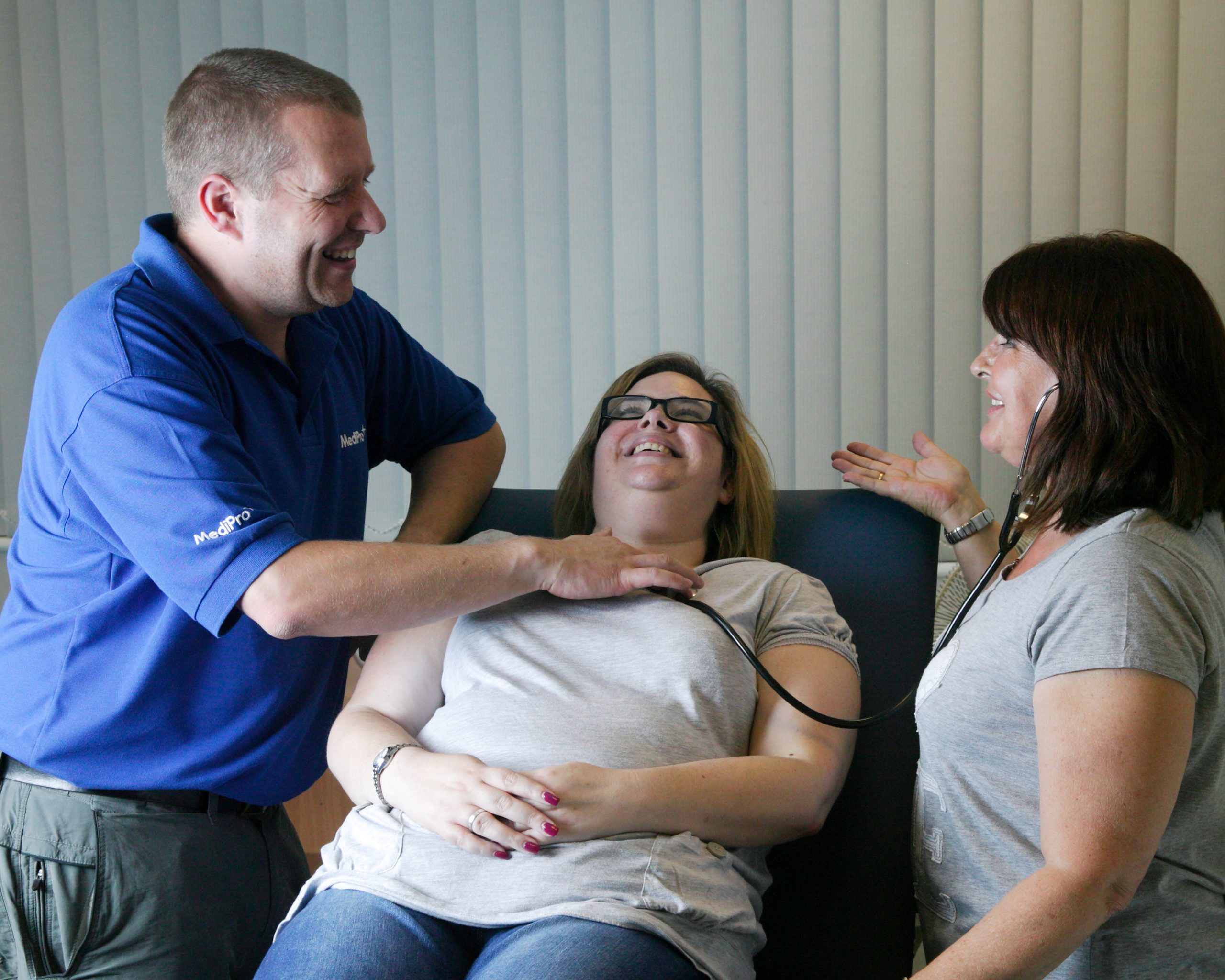
Two full days of supervised examination practice. The theory is done before you arrive.

Most courses like this spend the first morning on slides. We put all of that into online eLearning you complete beforehand, which means both days in our centre are spent with your hands on a patient, being watched and corrected by someone who examines patients for a living.

Where this sits

If you are building the assessment skills that underpin advanced practice or prescribing, you have broadly two options. A university Level 6 or 7 module carries academic credit but runs over roughly six study days, costs considerably more, requires a practice supervisor and is academically gated. A commercial workshop gives you the practical skills but little structure and no real evidence of competence.

This sits deliberately between them. Shorter and more affordable than the academic route, better structured and properly assessed compared with a straight workshop.

Who it is for

Paramedics, nurses, allied health professionals and anyone moving into advanced practice or prescribing roles. You should be a registered healthcare professional or have relevant clinical experience.

What the two days look like

Both days run roughly 9:00 to 16:30 at our Stockton-on-Tees centre, and both are hands-on throughout — supervised practice on peers and simulated patients, with continuous feedback.

  • Day 1 — history taking and cardiorespiratory examination. Observed, structured history taking with simulated patients. Full cardiovascular examination, demonstrated then practised. Respiratory examination and correlating findings with the history. Then linking findings to differentials, with documentation and handover practice.
  • Day 2 — abdominal, neurological and musculoskeletal examination. Abdominal examination and regional red flags. Focused cranial nerve and limb examination. Musculoskeletal look, feel, move and the key special tests across the major joints. Red flags across systems, then the integrated assessment.

Who teaches it

Experienced registered clinicians who still practise — people who assess patients every day rather than people who used to. On a course built entirely around technique and judgement, that is the difference between being shown a sequence and being taught what you are actually feeling for.

You are assessed, not just attended

Day 2 finishes with OSCE-style stations across the systems, assessed against defined criteria with individual feedback. You leave with evidence of what you can do, not just a register signature.

You can add the following when booking your course. It is not included in the £350 course fee.

Accommodation – from £75 per night

Add the number of nights you need at our learner rate. Two classroom days means two nights. At £75 that is £150, with breakfast and parking included. See the Accommodation section below for full details.

Across the online eLearning and two in-class days, you will be able to:

  • Take a clinical history – structure the interview, build rapport and explore the presenting complaint systematically.
  • Examine each system – cardiovascular, respiratory, abdominal, neurological and musculoskeletal, using correct technique.
  • Recognise red flags – identify indicators that require urgent escalation.
  • Reason clinically – link symptoms and findings to differential diagnoses and decisions.
  • Practise hands-on – examination techniques and assessment tools, applied with peers and simulated patients.
  • Document and communicate – record findings clearly and hand over confidently.

The eleven online modules

Completed before you attend, so the classroom days stay practical.

  1. Foundations of Patient Assessment and the Consultation — the diagnostic process, recognised consultation models such as Calgary–Cambridge, building rapport and setting the agenda.
  2. Taking a Comprehensive Clinical History — presenting complaint and history of presenting complaint using SOCRATES, past medical, drug and allergy, family and social history, and a structured systems review.
  3. Communication, Shared Decision-Making and the Challenging Consultation — eliciting ideas, concerns and expectations, adapting to health literacy and culture, and remote consultation.
  4. Clinical Reasoning, Differential Diagnosis and Cognitive Bias — hypothesis generation, refining a differential, the biases that catch people out, and effective safety-netting.
  5. Applied Anatomy and Physiology for Examination — a focused refresher underpinning each system you will examine.
  6. Principles of Physical Examination — inspection, palpation, percussion and auscultation, general inspection, vital signs in context, chaperoning, consent and infection prevention.
  7. Cardiovascular and Respiratory Examination (theory) — sequence, surface anatomy, expected findings and common abnormal signs.
  8. Abdominal and Gastrointestinal Examination (theory) — the structured approach, regional anatomy and common abnormal findings.
  9. Neurological and Musculoskeletal Examination (theory) — focused neurological examination including cranial nerves, limbs and coordination, and the look, feel, move approach with special tests.
  10. Recognising Red Flags, Safety-Netting and Escalation — red-flag presentations across systems, thresholds for urgent action, and escalating within your scope of practice.
  11. Clinical Documentation and Communication — recording findings defensibly using SOAP, structured handover using SBAR, and confidentiality.

Each module ends with a knowledge check.

A MediPro CPD certificate confirming the CPD hours completed and the examination competencies assessed.

How you are assessed

Assessment runs throughout rather than arriving at the end.

  • Knowledge checks at the end of each online module
  • Observed history taking with simulated patients on Day 1, with feedback
  • Practical observation of each system examination as you perform it
  • OSCE-style stations on Day 2 across the cardiovascular, respiratory, abdominal, neurological and musculoskeletal systems, assessed against defined criteria
  • Documentation assessed within the stations, not separately

You get individual feedback on every station. The point is to leave knowing where you are strong and where you still need supervised practice.

Where it leads

This is a recognised stepping stone towards advanced practice and prescribing roles. It is CPD rather than an academic qualification — if you need credits towards a degree, a university module is the route, and we will say so rather than sell you the wrong thing.

  • You are a registered healthcare professional, or have relevant clinical experience.
  • You complete the online eLearning before attending. The two classroom days assume it and there is no time to cover the theory again.
  • You are willing to examine and be examined by peers. Much of the practice is peer-to-peer alongside simulated patients. Tell us in advance if that presents any difficulty and we will work around it.

No prior examination training is assumed. Plenty of people arrive having picked technique up on the job and want it done properly.

£350 including VAT — or £297.50 each when you book four or more. Covers the online eLearning, both classroom days, all assessment and your certificate.

Multiple booking discount

Employers booking four or more learners receive 15% off the total, including any optional services added at checkout.

Returning learners

Trained with us before? When you come back to requalify, take 10% off your refresher.

Course fee money-back guarantee

Attend the course, complete the learning and follow your tutor’s guidance. If you still do not pass, we refund your course fee. On eligible courses.

Secure your place with a 20% deposit

Pay 20% at checkout to secure your place on the date you want. The balance is due before your course starts.

Pay in full with Klarna

Choose Klarna at checkout and spread the cost on Klarna’s terms. Subject to Klarna’s eligibility checks.

Employer invoicing

Employers booking several people can be invoiced rather than paying at checkout. Get in touch and we will set it up.

In-house delivery

For teams of ten or more we deliver the classroom days at your premises. Your staff complete the eLearning beforehand as usual. Ask for a quote.

Staying overnight

Travelling to us from outside Teesside? We have agreed learner rates with the Sporting Lodge Inn at Stainton, a 5 to 10 minute drive from our Stockton-on-Tees centre, with easy access from the A19 and A174.

  • £75 per night — bed and breakfast
  • £95 per night — dinner, bed and breakfast, including a two-course evening meal and a drink

Both rates include free on-site parking and free use of the hotel gym and 25-metre pool. There is a pub and restaurant on site.

These rates are only available through us, not directly with the hotel. Add the nights you need to your checkout when you book your course, and we will arrange it and confirm the details with you.

Two classroom days means two nights. At £75 that is £150, with breakfast and parking included.

Rooms are subject to availability, so book as early as you can. Plans change — cancel your room up to 24 hours before arrival and we will refund it.

Download our Teesside accommodation and local area guide for learners (PDF)

Our centre is Faraday House, Sopwith Close, Stockton-on-Tees, TS18 3TT, with free on-site parking and direct access from the A66 and A19.

By rail

Darlington sits on the East Coast Mainline, under three hours from London King’s Cross, with direct services from Edinburgh, Newcastle, York and Leeds. Eaglescliffe is the nearest station to the centre, with parking, cycle storage and ticket facilities.

By air

Teesside International Airport is around twenty minutes away and Newcastle Airport about an hour, with direct flights from Aberdeen, Belfast and Dublin.

What it costs to attend

Teesside is straightforward to reach from anywhere in the UK, and cheaper to stay in than most training locations. Two days here, rather than six study days on an academic module, is the real saving.

Is this an academic qualification?

No. It is CPD, assessed by OSCE-style stations, with a MediPro CPD certificate. If you need academic credit towards a degree, a university Level 6 or 7 module is the route — those run over roughly six study days, cost considerably more and need a practice supervisor. We would rather point you there than sell you the wrong thing.

How much of it is hands-on?

Both classroom days, almost entirely. The theory is in the online modules you complete beforehand, which is the whole reason the course is built this way.

How long does the eLearning take?

Eleven modules, each ending with a knowledge check, worked through at your own pace before you attend. You need to have finished it before Day 1 because the classroom time assumes it.

Who will I be examining?

Peers and simulated patients, supervised throughout. If peer examination is difficult for you for any reason, tell us when you book and we will work around it.

Do I need to be a nurse or paramedic?

You should be a registered healthcare professional or have relevant clinical experience. Paramedics, nurses and allied health professionals make up most cohorts, often people moving towards prescribing or advanced practice.

What if I have never examined formally before?

That is common and it is fine. Many people arrive having picked technique up on the job and want it done properly for the first time. The online modules start from the principles.

Which systems are covered?

Cardiovascular, respiratory, abdominal, neurological and musculoskeletal. Cardiovascular and respiratory on Day 1, the other three on Day 2.

What happens in the assessment?

OSCE-style stations on the afternoon of Day 2, spanning the systems, assessed against defined criteria with individual feedback on each. Documentation is assessed within the stations rather than separately.

Will this let me prescribe?

No. Prescribing requires a separate accredited programme. This builds the assessment skills that underpin it, which is why people often take it before or alongside applying for a prescribing course.

Who teaches it?

Experienced registered clinicians who still practise — people who assess patients every day.

Can you deliver this for our team?

Yes, for ten or more, at your premises. Your staff complete the eLearning beforehand as usual. Ask us for a quote.

Where is the centre and is there parking?

Faraday House, Sopwith Close, Stockton-on-Tees TS18 3TT, with free parking directly outside. Straight off the A19 and A66.

What should I wear?

Comfortable clothing you can examine and be examined in. You will be working on peers and simulated patients throughout both days.

Over 10,000 people have begun their clinical career with us.

We support NHS ambulance services, dental practices, community pharmacies, care providers and offshore operators. Here is what some of them say.

Want to know more?

Complete our short online form for more information about any of our programmes or to find out how we can work with your organisation to develop your employees

Get In Touch Today
Menu
Basket

No products in the basket.

Basket

No products in the basket.